


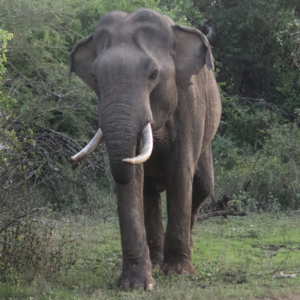
16-year-old Hesandi shares the stories of famous wild elephants in her homeland
Tuskers, male or bull elephants with tusks, play a vital role in wildlife tourism in Sri Lanka, appearing on the logo of the Department of Wildlife Conservation.
Although both male and female African elephants have tusks, they only appear in some male Asian elephants – usually around the age of two. Essentially elongated teeth, they are important tools used for digging, foraging and defence.
According to Sri Lankan environment minister Dammika Patabendi, the country’s wild elephant population has increased by 26.7%, rising from 5,879 elephants in 2011 to 7,451 in 2024. The tusker population has increased by 9.2% in the same period.
Harbingers’ Weekly Brief
Subscribe to the Harbingers’ Weekly Brief, a newsletter written by the editorial board of Harbingers’ Magazine, the world’s youngest newsroom, delivered to your inbox every Monday morning.
![slide image]()
![image]()
![author_bio]()
![author_bio]()


Dr Prithiviraj Fernando, chair of Sri Lanka’s Centre of Conservation and Research, told Harbingers’ that tuskers are not rare across South Asia – in fact, 95% of bull elephants are tuskers. However, Sri Lanka has the lowest percentage of tuskers in the region, just 7% of the country’s elephant population.
“This is because we love tuskers!. In fact we have loved them to death!” said Fernando. “For thousands of years, we’ve captured tuskers from the wild and kept them in captivity as we prize them much more.”
He explained that the number one cause of death for tuskers is the human-elephant conflict, the second is poaching. “Elephant conservation is important, not just tusker conservation; once that happens, tuskers will be conserved automatically,” he added.
Throughout Sri Lanka’s history, many tuskers have been treated as symbols of strength and national heritage, often carrying the names of ancient kings. Each has its own story, reputation and place in the island’s landscape. Below, we tell the stories of some of the country’s most famous tuskers.
View this post on Instagram
Kawantissa
Kawantissa, named after the renowned ancient king, Kawan Tissa of Sri Lanka, roams the Galgamuwa range forest in the northwest of the country. Estimated to be around 50–60 years old, this majestic tusker was first spotted in 2008 and earned his name in 2015. Standing at around 3.4 metres tall with tusks over 1.8 metres long, Kawantissa is considered the tallest elephant in Sri Lanka.
During the rainy season, Kawantissa ventures uphill to avoid floods, returning only once the rain starts to stop. During the dry season, like many other elephants, he takes elephant corridors – paths to resources made by elephants over generations – to the nearest waterholes.
He and other elephants also frequent nearby salt licks, gaining additional nutrients and also socialising with one another.
Although Kawantissa has probably damaged property and fields belonging to the villagers around Galgamuwa, he is not known to have harmed anyone.
Chandi
Also hailing from the Galgamuwa area, this one-tusked elephant earned the endearing nickname Galgamuwe Chandi, meaning ‘Gangster of Galgamuwa’.
Pushed by habitat loss and scarce resources, Chandi had a history of crop raiding. As a result, in 2009 he was fitted with a GPS collar and relocated to Somawathiya National Park. However, the determined elephant found his way back home after travelling a distance of nearly 250 km over 28 days.
In 2015, he was moved to the brutal Horowpathana Elephant Holding Grounds (EHG), a facility used to confine elephants labelled as “problem animals” after repeated conflict with humans. But Chandi managed to escape and make his way back to Galgamuwa again, even removing his GPS collar himself along the way. This happened again in 2019.
By his mid-fifties, Chandi was old, frail and blind. Moving him again would cause unnecessary stress and trauma, putting his life at risk. In 2023, when authorities prepared to relocate him once more, public outcry forced them to stop. By then, his story had touched the hearts of many, and it was clear that Chandi belonged to Galgamuwa.
Aside from being a master escape artist, Chandi was also well known for his taste for alcohol. The tusker used to raid villages for kasippu, an illegal spirit, and was often found intoxicated in a lake.
Unfortunately, on 5 July 2024, Chandi was found near the lake for the last time after a deadly fight with another tusker.
Gemunu
Named after the celebrated warrior king Dutu Gemunu, this tusker was born in 1991 and calls Yala National Park, in southeastern Sri Lanka, his home. In his youth Gemunu dominated the park, becoming both a celebrity and a nuisance due to his lack of fear of humans and habit of raiding vehicles for food. His fame used to cause traffic jams in the middle of the jungle.
In 2018, Gemunu fought with two new tuskers, Sando and Parakum, and lost a tusk in the process. However, his confidence remained intact as he continued to rule the park, though a bit more cautiously.
In 2020, Gemunu lost his remaining tusk in another fight, this time with the formidable tusker Nadimithra. Ironically Nandimithra was named after one of the great, loyal warriors of King Dutu Gemunu’s army.
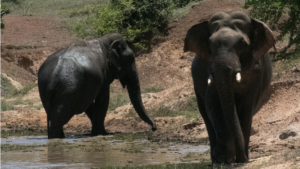
Sando
After his fight with Gemunu in 2018, Sando quickly became popular among tourists visiting Yala because of his aggressive nature. Estimated to be around 35 years old, he spent most of his time in Yala Block II, a restricted area of the park.
During the musth period (the mating season for male elephants), he travelled to Yala Block I, where tourists are permitted, to find a mate. During this period, bull elephants are extremely aggressive and often charge on sight. Some tourists would harass Sando for the thrill of being chased by him.
In late 2024, Sando went missing. In mid-2025, a skull with missing tusks (suspected to have been stolen) was discovered, leading many to speculate it belonged to Sando. However, no official confirmation has been made.
Bullet
Bullet (also known as Senadhi) was brought to the Elephant Transit Home in Udawalawe, in southern Sri Lanka, when he was about six months old. He earned his nickname because a bullet was found embedded near his jaw. He was released into Udawalawe National Park in 2003, aged five.
He is known for waiting by electric fences for people to give him food. For tuskers like Bullet, that lack of hesitation around humans puts him at higher risk of being poached.
Bathiya
Loved by photographers, Bathiya was frequently seen in Kalawewa National Park in northwestern Sri Lanka. His decline began when he was shot in the right leg by a trap gun, often used for poaching smaller animals.
Sometime later, he was shot behind the ear, while his leg was infected and swollen. He was found lying in a muddy pit close to where he lived.
Authorities began treating him for his injuries alongside two other elephants with gunshot wounds, one of them another tusker, named Yasa. On 15 July 2025, Bathiya met his tragic end.
Maha Poottuwa and Podi Poottuwa
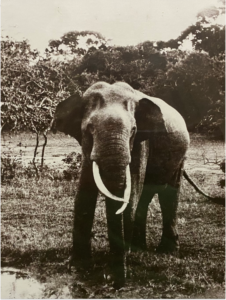
Maha Poottuwa, one of Sri Lanka’s most iconic tuskers, in the 1970s.
Two famous tuskers from the past, both from Yala National Park, were Maha Poottuwa (meaning ‘Big Crossed One’) and Podi Poottuwa (‘Small Crossed One’) – so named for their distinctive overlapping tusks.
First spotted in the late 1950s, Maha Poottuwa was known as a hot-tempered elephant who charged at vehicles on sight. By the 1970s, he was one of the most photographed elephants in the park. He disappeared in the 1990s.
Podi Poottuwa also became famous around the 1970s, but was shot and killed in the mid-’80s.

Edited by:

© 2026 The Oxford School for the Future

