


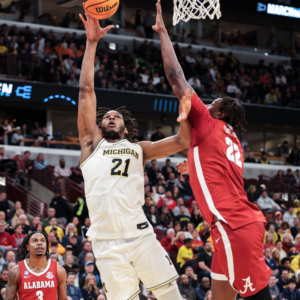
16-year-old Jennifer explains the appeal of the annual US men’s collegiate basketball tournament
Across the US, the arrival of March brings warmer weather, blooming flowers, Spring Break, St Patrick’s Day and, arguably the most important, March Madness. Suddenly, everyone, from die-hard sports fans to people who don’t follow sports at all, is glued to their screens.
Welcome to a basketball tournament full of unpredictability and excitement.
March Madness – officially the NCAA (National Collegiate Athletic Association) Division I men’s basketball tournament – is a single-elimination (or knockout) tournament of 68 collegiate/university teams where the last team standing is crowned national champions. First held in 1939, it lasts three weeks.
View this post on Instagram
Teams are placed in one of four regions and ranked from 1st to 16th seed based on their season’s performance. They compete in seven rounds in the hope of reaching the penultimate round, known as the Final Four, to “punch a ticket” (qualify) for the final.
Winning, doing well or being a standout player in the tournament can catch the attention of scouts and land you a spot in the NBA – the National Basketball Association, the US’s professional basketball league. Many famous NBA players were previous March Madness Heroes.
Harbingers’ Weekly Brief
Subscribe to the Harbingers’ Weekly Brief, a newsletter written by the editorial board of Harbingers’ Magazine, the world’s youngest newsroom, delivered to your inbox every Monday morning.
![slide image]()
![author_bio]()
![author_bio]()


Golden State Warriors’ star player Steph Curry brought the underdogs Davidson Wildcats all the way to the Elite Eight in 2008 with multiple standout performances. Anthony Davis of the LA Lakers led the Kentucky Wildcats to their eighth NCAA title in 2012, bagging the MVP (most valuable player) award at the same time.
Other famous names have also won the tournament during their college career, including Michael Jordan, Magic Johnson, Bill Russell and Kareem Abdul-Jabbar.
So, what makes March Madness different from many professional sports leagues? Unpredictability. Usually, the dominant teams or reigning champions control the narrative. Easy lineups or nailing the number 1 draft pick (here’s a useful guide to basketball terminology) can make your season. But March Madness is full of surprises.
The knockout format means that one bad game will end a team’s entire season, no matter their ranking or record. The high-stakes pressure creates moments where anything can happen – and they often do.
This year’s March Madness lived up to the hype, with an average of 10.3 million viewers during the Elite Eight (the final eight teams). The tournament was full of exciting matchups and heartbreaking upsets, all coming together in a thrilling final between UConn (University of Connecticut) and Michigan (University of Michigan). The favoured Michigan Wolverines emerged victorious.
Despite missing out on the national championships, UConn pulled off a big upset with a “buzzer beater” in the Elite Eight by knocking out tournament favourites Duke.
Other standout moments that captured fans’ hearts included: 9th-seed Iowa (University of Iowa) beat defending champions UF (University of Florida); 11th-seed VCU (Virginia Commonwealth University)’s major comeback against UNC (University of North Carolina); and 12th-seed High Point (High Point University) beat Wisconsin (University of Wisconsin).
Cinderellas, community and the bracket
But aside from the exciting game of basketball itself, what makes this tournament so special? How does a collegiate competition go beyond the sport to captivate such a massive and diverse audience? It all boils down to the bracket – basically, a table of results.

The tournament comes with a bracket challenge. Filling out a March Madness bracket is a ritual for many Americans. The rules are simple: predict the outcome of every game. Whether you’re carefully studying team stats or picking winners based on vibes and colour, it is a simple game that anyone can participate in.
The odds of creating a perfect bracket has the probability of 1 in 9.2 quintillion, giving the game low stakes and adding to the fun.
Predictions going wrong only adds to the madness! When a low-seed team knocks a favourite, millions of brackets are immediately busted. These are called “Cinderella moments”, when underdogs defy critics, which is what makes the tournament so enjoyable.

With the rise of social media, the shared excitement has been brought to another level. TikTok and Instagram are filled with highlights, reactions, opinions and memes. One buzzer beater or one missed pass can turn a player from hero to zero. This never-ending cycle of streams keeps fans engaged long after the final buzzer rings.
It turns the tournament into a conversation. Whether you’re posting your bracket or reacting to a post, you become part of something bigger. You become part of a community.
Families watch games together. Friends compete for perfect brackets. Classmates and colleagues bond over the scoreboard. At a time where the world feels so divided, such shared excitement matters. For a few weeks, people from all different backgrounds are brought together by upsets and celebration.
So whether your predicted national champions were eliminated by week two or walked away with the title, you are part of the madness.

Edited by:

© 2026 The Oxford School for the Future

